
Summit County Projected Release Dates
A projected date is a calculation or decision point that may change before departure. An actual release date records a completed event. ODRC's exact public label is Expected Release Date/Parole Eligibility Date, which deliberately combines two concepts. Depending on the sentence, the field may reflect a projected or presumptive point, or the date when parole consideration becomes possible. It should never be relabeled as a completed release.
A pretrial detainee at Summit County Jail generally has no calculated prison release date. Bond, dismissal, plea, sentencing, court orders, and other agency holds may affect when the person can leave. Even a favorable hearing does not complete the jail's work. For a local sentence, the court entry, jail-time credit, and Sheriff's release record are the relevant sources. ODRC earned credit does not calculate a county-jail term.
- Projected release date
- A changeable calculation or board-set date, often shortened to PRD.
- Parole eligibility
- The first point when a qualifying case may be considered for discretionary parole, not a promised exit.
- Jail-time credit
- Qualifying time credited toward the sentence under the controlling record.
- Detainer
- A request or legal hold that may send a person to another agency instead of the community.
Find Summit County Projected Release Dates
First determine whether the person is at Summit County Jail, in an Ohio prison, or already on state supervision. The county roster covers current local custody only. The ODRC Offender Search covers Ohio prison and APA records. Someone who left the Summit jail for an ODRC institution may take time to appear in the state system, so the court judgment and jail transfer entry can bridge the gap.
- Identify the custody system and obtain the full name, date of birth, case number, booking number, or ODRC number available.
- For an Ohio prisoner, search ODRC by number or name and compare the county, docket, offense, admission date, and institution.
- Read status first. Then review aggregate sentence, jail-time credit, expected or eligibility date, POA/PRD, and hearing fields.
- For Summit County Jail, open the charging court docket and locate the journalized bond, sentence, dismissal, or release order.
- Confirm physical departure or transfer with the jail release record or the responsible state agency.
The state form offers last and first name, county of commitment, residential county, ZIP code, status, parole-hearing month, offender number, and sorting. ODRC itself spells the form label County of Committment. Use Summit in that field for a Summit sentencing origin, but remember concurrent multi-county cases can affect which county is reported.
The official search screen displays the fields and status choices used for a state release-date lookup.
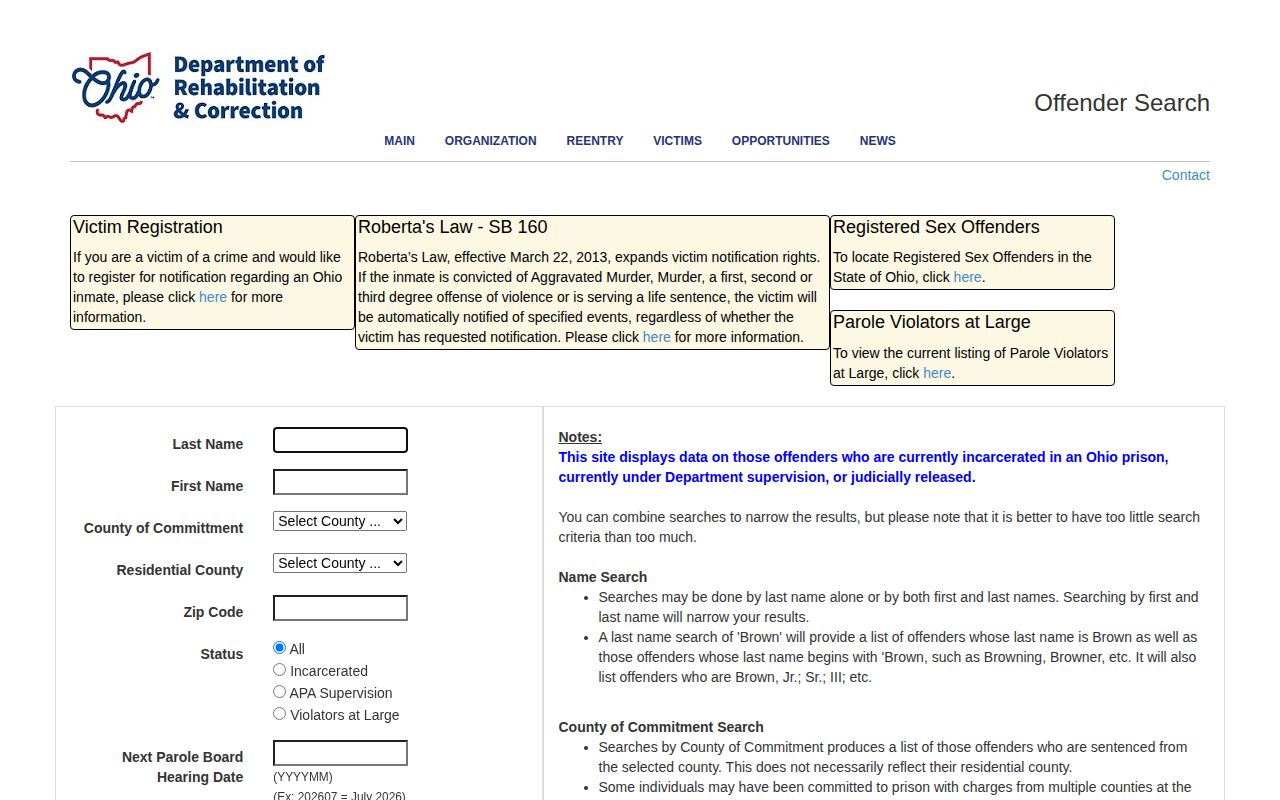
Open the individual result after searching. A county filter alone should not replace a comparison of the offender number, identity, case, and sentence.
Note: Residential County narrows APA records; it is not a list of all people sentenced by a Summit County court.
Summit County ODRC Date Labels
ODRC defines PRD as projected release date and POA as parole on or after. Its POA/PRD Date is described as the earliest date on which the inmate will be released on APA supervision. Even that label may depend on later action, processing, or rescission. A future parole-board hearing month is not a release date. ODRC says review usually occurs about two months before the displayed future month.
Read the combined expected or eligibility field beside status, admission date, institution, effective sentence date, aggregate sentence, jail-time credit, offense, county, and docket. Supervision start, period of supervision, APA office, and hearing results can clarify what happened later. APA SUPERVISION plus a start date supports actual departure from prison to state supervision. A past expected date with no matching status change requires more checking.
| ODRC field | Careful reading |
|---|---|
| Expected Release Date/Parole Eligibility Date | A projection, presumptive point, or eligibility date based on sentence type |
| POA/PRD Date | Earliest stated date for release to APA supervision, still subject to later action |
| Next Parole Board Hearing/Review Month | A review month, not a scheduled departure day |
| Supervision Start Date | Evidence that a state-prison release to supervision began |
| Status | Current state label that must be read before interpreting any date |
The ODRC definitions page is the source for Released, APA, VAL, expected-date, POA, and PRD terms.
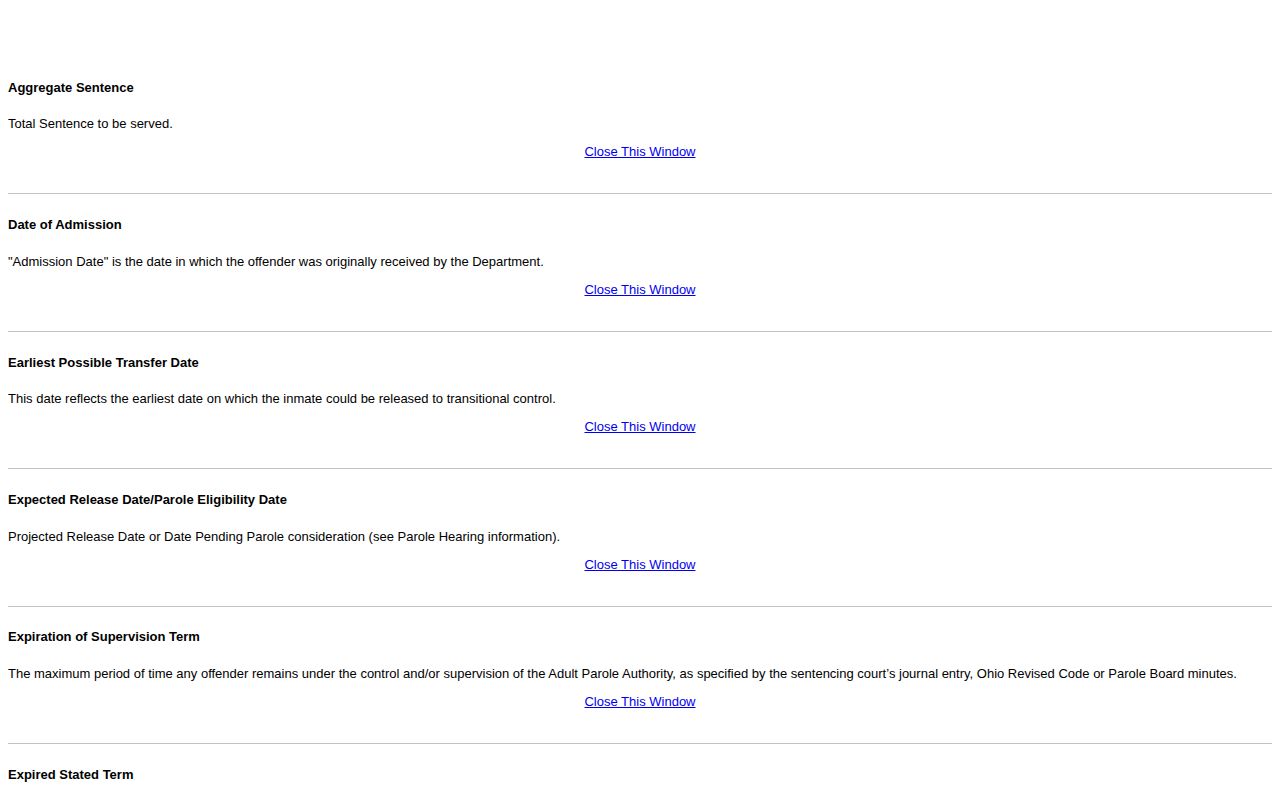
Those agency definitions protect against a common error: turning an eligibility marker into a promise that release will occur on that day.
Ohio Credit for Summit County Sentences
Current Ohio Revised Code 2967.194 applies to confinement on and after April 4, 2024. Eligible prisoners may provisionally earn five days for each completed month of qualifying participation. A one-day category applies to certain sexually oriented offenses committed before September 30, 2011. Specified program completions can yield ninety days or ten percent of the stated term, whichever is less, subject to the statute's exclusions and rules.
Ordinary participation and completion credits governed by division (A)(4) cannot exceed fifteen percent of the stated prison term. That supports a narrow explanation: for an eligible modern stated prison term, ordinary earned credit alone generally cannot reduce the term below about eighty-five percent. It does not mean every Ohio prisoner serves exactly that share. Credit must be earned and can be denied or withdrawn. Mandatory terms and several sentence or offense categories are excluded.
Time before April 4, 2024 follows the applicable former statute. Older versions used one-day or five-day monthly categories and, during relevant periods, an ordinary eight-percent aggregate ceiling. Pre-Senate Bill 2 sentences can involve other calculations. Do not apply today's cap as a full formula for an older Summit County case. Jail-time credit, judicial release, transitional control, discretionary parole, and indefinite-sentence rules also operate separately.
The manifest capture comes from the current Ohio earned-credit statute.
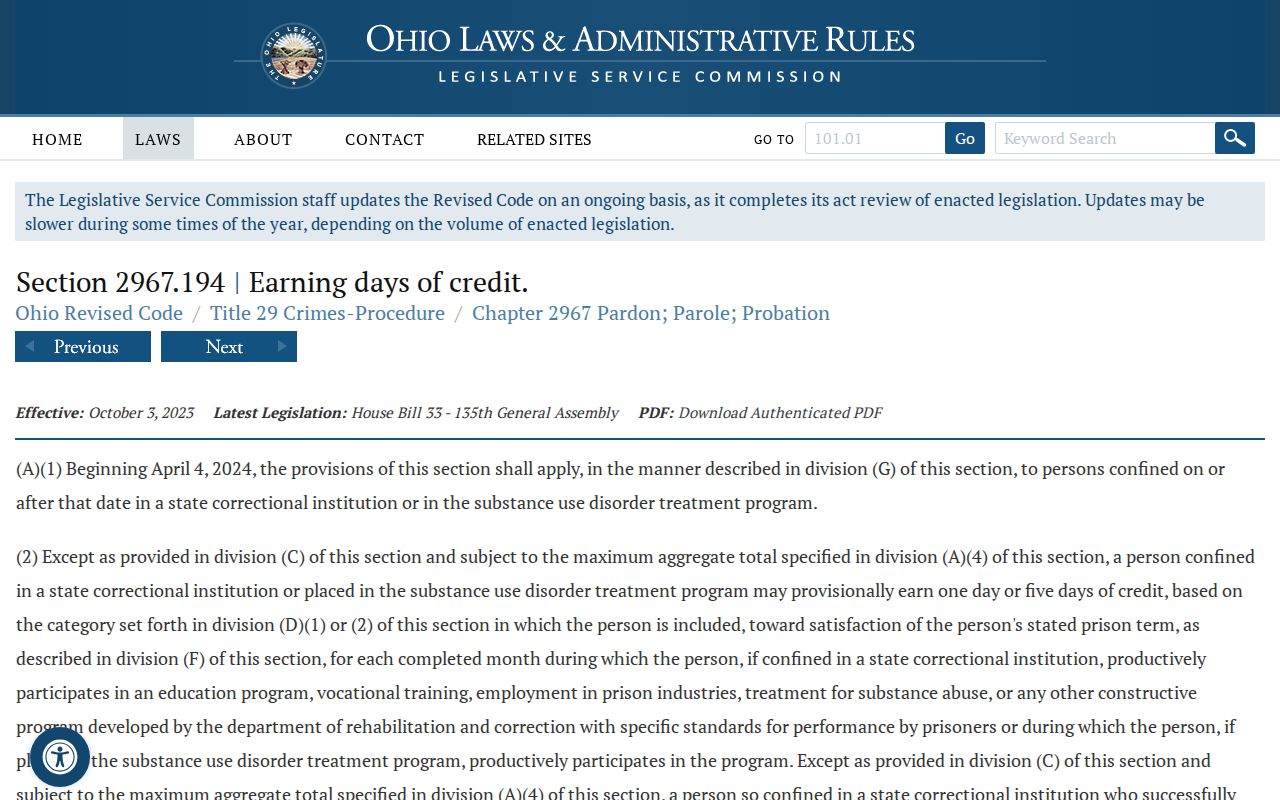
The full statute, not a simple percentage, controls eligibility, exclusions, provisional credit, program awards, and loss of credit.
Note: The qualified eighty-five-percent point concerns ordinary earned credit for eligible modern prison terms, not every Ohio sentence.
Summit County Sentence Date Frameworks
Ohio sentence type changes what a displayed date means. Ohio Administrative Code 5120-2-03.2 addresses sentence-era computation and jail credit. Ohio Revised Code 2967.271 establishes the Reagan Tokes framework for non-life felony indefinite terms. Under it, release is presumptive at the minimum or presumptive point unless the state makes statutory findings to extend confinement, and custody cannot exceed the judicial maximum.
Parole-eligible sentences follow another path. Ohio Revised Code 2967.13 sets general eligibility rules. Eligibility varies by sentence, and life without parole is ineligible. A Parole Board date is a point for review or possible release, not a guarantee. Qualifying youth-offense review has separate treatment under Ohio Revised Code 2967.132.
A board-set PRD after denial is another distinct concept. Under Ohio Administrative Code 5120:1-1-10, the Parole Board may set a projected date as much as ten years ahead. It may accelerate or rescind that date, and the date creates no entitlement to release. The official rule image below shows the verified decision and PRD procedure.
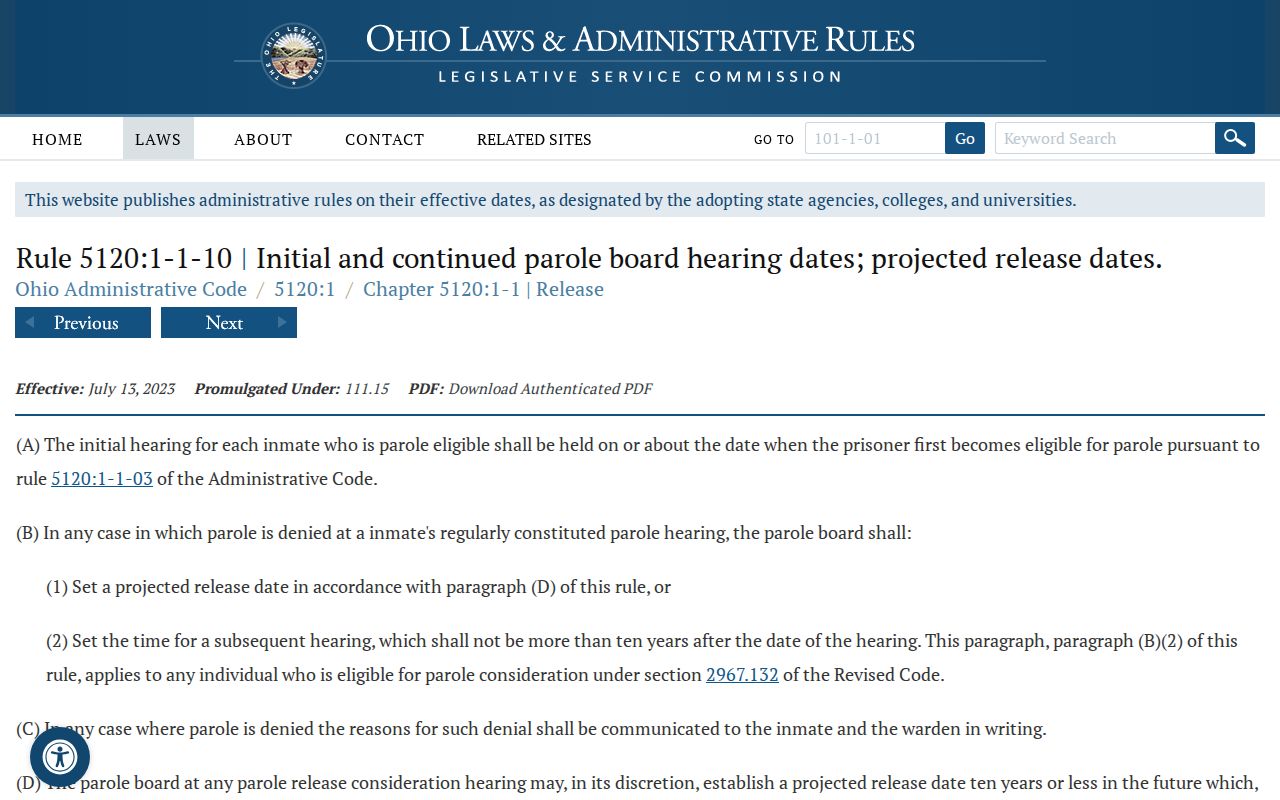
A board-set PRD and an ODRC sentence-computation projection may look similar in plain speech, but they arise from different authority and must remain distinct.
Why Summit County Release Dates Change
No single field captures every legal and operational change. Earned credit can be gained, denied, or withdrawn. A court can grant judicial release. A detainer may keep the person in custody for another agency. A parole decision can be denied, continued, accelerated, or rescinded. Sentence recalculation and jail-time-credit corrections can also affect the displayed projection.
| Factor | Possible effect | Where to verify |
|---|---|---|
| Earned credit | May reduce an eligible prison term within statutory limits | ODRC calculation and ORC 2967.194 |
| Credit loss or denial | May move a projected date later | ODRC sentence record |
| Judicial release | May permit release before an earlier projection | Sentencing court order and ODRC status |
| Parole action | May grant, deny, continue, accelerate, or rescind a release point | ODRC hearing result and board rules |
| Detainer or hold | May cause transfer or continued custody rather than release home | Jail or ODRC record and receiving agency |
| Court or credit correction | May alter the computed sentence | Journalized order and ODRC Central Records |
A displayed future date should always carry an as-of date. Keep the exact label and source. If ODRC and a Summit court entry conflict, the court controls its order and ODRC controls its prison calculation. Ask the originating office to resolve the mismatch instead of choosing the more favorable date.
Note: A transfer date marks movement between custodians and must not be described as an actual release to the community.
Summit County Jail Release Timing
Summit County Jail release timing is not computed with ODRC earned credit. The county facility holds people under local court authority, including pretrial cases and local sentences. The controlling facts are the court order, sentence, jail-time credit, bond or disposition, any other hold, and the jail's receipt and processing of paperwork. No Summit-specific county good-time formula was verified, so the state fifteen-percent discussion should never be applied to a county-jail term.
The Sheriff states that releases occur twenty-four hours a day, seven days a week. When morning court leads to release, paperwork commonly reaches the jail in mid-afternoon. The Sheriff's estimate is another two to three hours after receipt. This is an estimate, not a deadline. The sequence is court action, paperwork receipt, jail processing, hold check, and physical departure.
The jail does not accept bond payment. Payment goes through the clerk of the court with jurisdiction, after which the jail must receive and process the resulting documents. A bond receipt is proof of court-side activity, not proof that someone has left the building. The Summit Corrections FAQs documents this local delay.
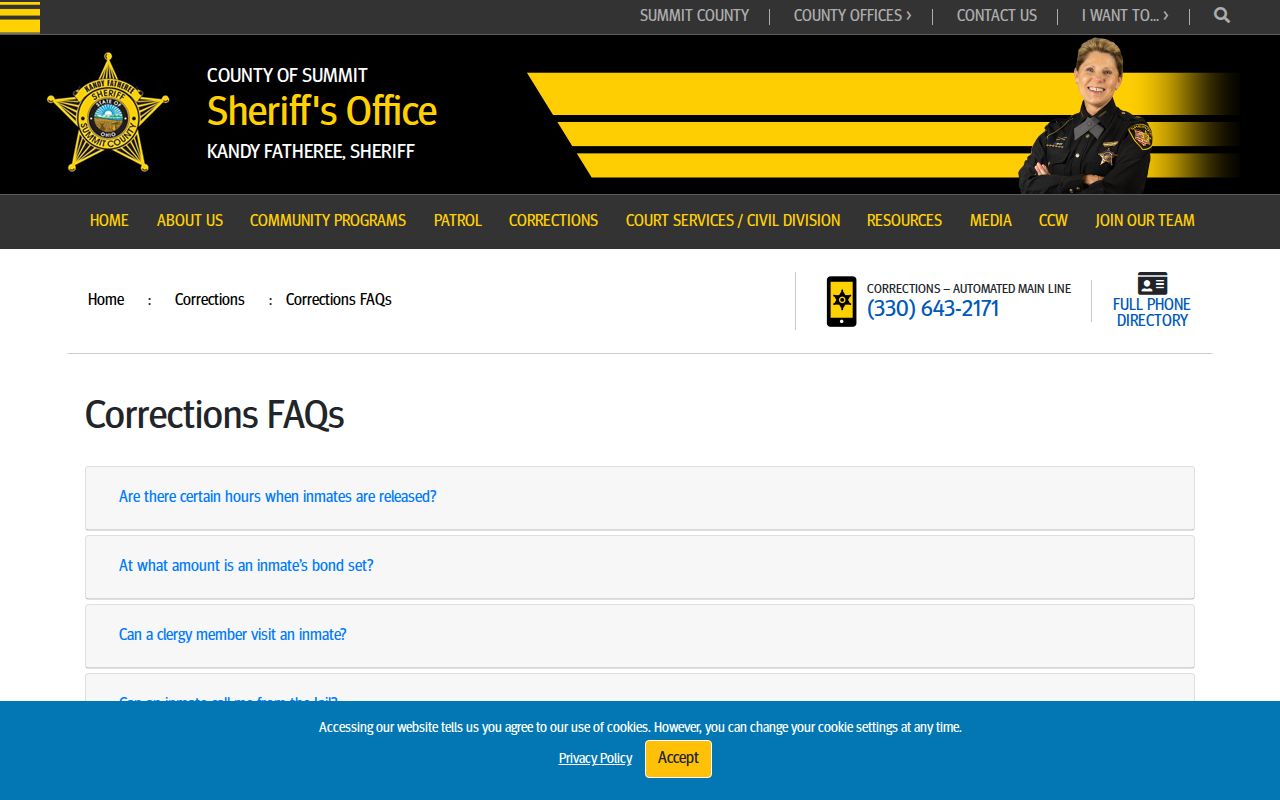
This timing source is useful for planning, but the physical release entry remains the record of when the jail's custody actually ended.
Confirm Summit County Actual Release
For Summit County Jail, pair the journalized entry in the Summit County court docket with the Sheriff's booking or release record. The Sheriff's records channel is the direct request route. Ask for the physical release date and time, disposition, and receiving agency if the departure was a transfer. A name disappearing from the active roster is only a clue. It can reflect community release, ODRC transfer, movement to another jail, federal custody, or immigration custody.
For an Ohio prisoner, read ODRC status with the projected fields. APA SUPERVISION and a supervision start date are stronger proof of release from prison than a past expected date. Judicial release should be checked against the Summit sentencing order. A recent custody change can also be monitored through the Summit County VINE inmate check, but Ohio warns against relying on VINE alone.
Keep each conclusion narrow. “Release ordered” describes the court event. “Projected release” describes a changeable date. “Released from prison to APA supervision” describes a state status. “Physically released from Summit County Jail” should be used only after the facility event is confirmed. This language preserves the difference between legal authority, sentence calculation, processing, transfer, and actual departure.