
Summit County Parole and Probation
Parole and probation are not interchangeable. In Ohio, parole is a form of supervised release from prison that generally applies to eligible old-law or life sentences. The Ohio Adult Parole Authority, part of the Ohio Department of Rehabilitation and Correction, supervises parole. Post-release control is also state supervision after prison, but it follows qualifying modern prison terms when the sentencing entry includes it. Ohio Revised Code 2967.28 governs post-release control. A public ODRC record may group these forms under an APA SUPERVISION status.
Probation is the familiar name for court supervision. Ohio court records often call it community control. A Summit County Common Pleas judge may impose community control instead of prison or after judicial release. The Summit County Clerk docket, the sentencing entry, and Adult Probation are the right sources. An empty ODRC result does not prove that a person has no probation. ODRC does not provide one statewide public database for ordinary county probation. The court that issued the order controls that record.
| Supervision | Who controls it | Best public check |
|---|---|---|
| Parole | Ohio Adult Parole Authority | ODRC status, hearing fields, and APA office |
| Post-release control | Ohio Adult Parole Authority | ODRC APA status plus the sentencing entry |
| Probation or community control | Summit County court and Adult Probation | Charging court docket and journalized orders |
| Judicial release | Sentencing court, with supervision as ordered | Court order, ODRC release status, and placement records |
- Discharge
- The formal end of a supervision term or legal obligation shown by the responsible agency or court.
- Absconder
- A person alleged to have stopped reporting or otherwise left supervision without authorization.
- Community control
- Ohio court supervision commonly called probation.
- APA supervision
- Supervision administered by the Ohio Adult Parole Authority after state-prison release.
Verify Summit County Post-Release Supervision
Start with the custody path. Someone released from an Ohio prison may have an ODRC record showing APA supervision, a supervision start date, a period of supervision, and an APA office. Someone sentenced to Summit County community control may appear only in the court docket. A person can also have more than one case. Compare full name, date of birth, offender number, case number, offense, and sentence before drawing a conclusion.
The ODRC Offender Search allows searches by name or an A, R, or W-prefixed offender number. Its form also offers status, county of commitment, residential county, ZIP code, and parole-hearing month. County of commitment concerns the case origin. Residential county is used for state-supervision records. Those fields should not be substituted for one another.
- Search ODRC by offender number when known. Otherwise begin with last name and add the first name only if needed.
- Open the matching detail and read the exact status before interpreting dates. Compare the number, date of birth, offense, county, and docket.
- For state supervision, review the supervision start, period, POA/PRD date, and named APA office.
- Search the Summit County Clerk docket for community control, judicial release, later violation, termination, or discharge entries.
- Ask the responsible office to confirm a time-sensitive status. Preserve the displayed label and the date checked.
The official ODRC search screen shows how the state separates incarcerated, released, APA-supervised, and violator-at-large records.
View the ODRC search form at its source.
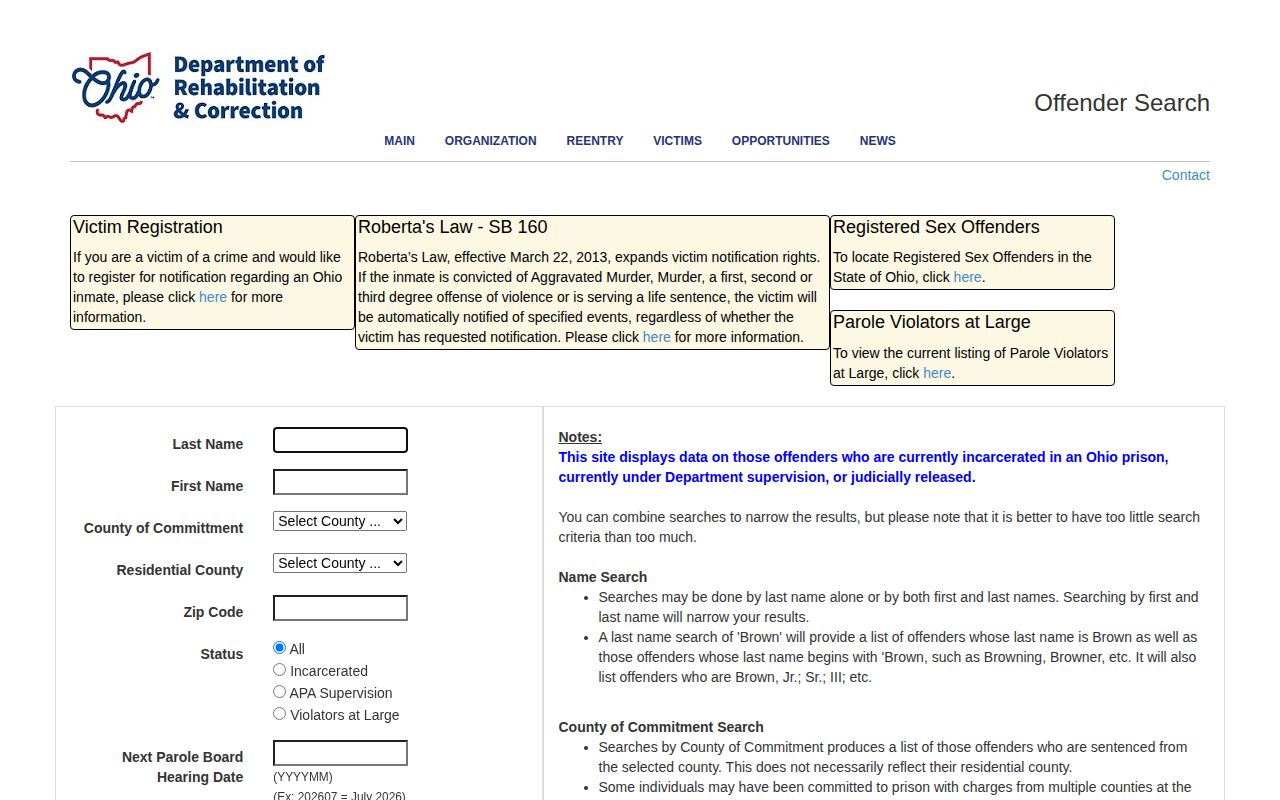
The county filters help narrow a search, but a name or offender-number match remains important because concurrent cases can affect the reported commitment county.
Note: A past expected date does not confirm release; state supervision status and the controlling court entry are stronger evidence.
Summit County APA Office Record
An official Summit-residential ODRC example identifies the APA office as AKRON 3. That is the verified public unit label. No current official address or telephone number for that unit was confirmed in the research, so an old directory listing should not be treated as current. Use the office label from the individual ODRC record and ask ODRC to confirm how to reach the assigned unit.
Verified Summit-area record label: AKRON 3
Confirm current office contact details through ODRC.
ODRC Offender Search
The official Summit-residential APA example demonstrates the office, supervision dates, and status fields without establishing a current status for anyone else.
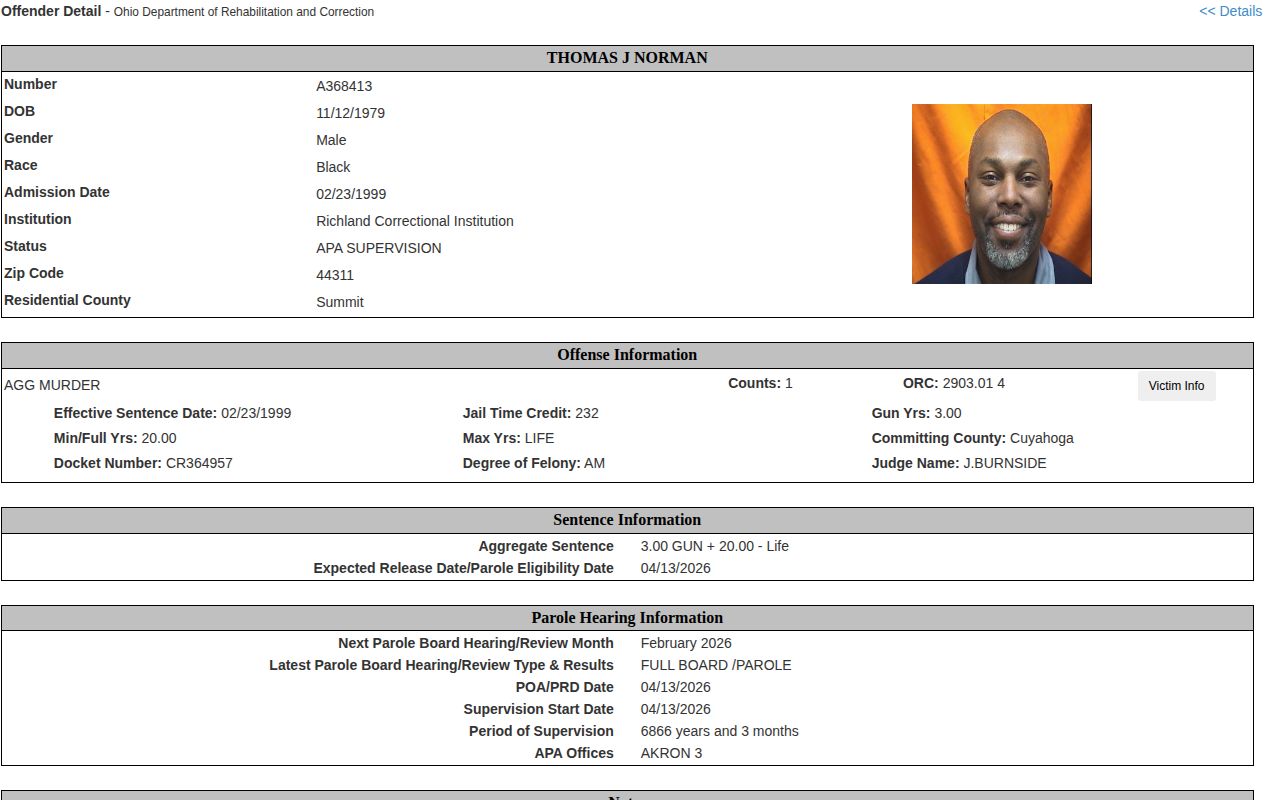
Readers should use those labels as an interface example, then search the correct individual record and protect personal identifiers when saving or sharing proof.
Summit County Supervision Violator Status
ODRC offers both a Violators at Large status filter and a separate public list. VAL means the person was released to APA supervision and is now alleged to have absconded. It is released-first evidence, not proof of current incarceration. The listed residential address is the last recorded address and is expressly not a current known location. A displayed status also should not be treated as permission for a private person to approach anyone.
The public listing may show a sequence number, photograph, full name, ODRC number, date of birth, declared-at-large date, and offenses. ODRC directs law enforcement to verify warrants through LEADS or NCIC, the official law-enforcement systems. A member of the public should report urgent information through law enforcement and use the ODRC entry only to understand the public status. The ODRC Parole Violators at Large list is the official public channel.
The manifest image captures that state listing and its cautionary context.
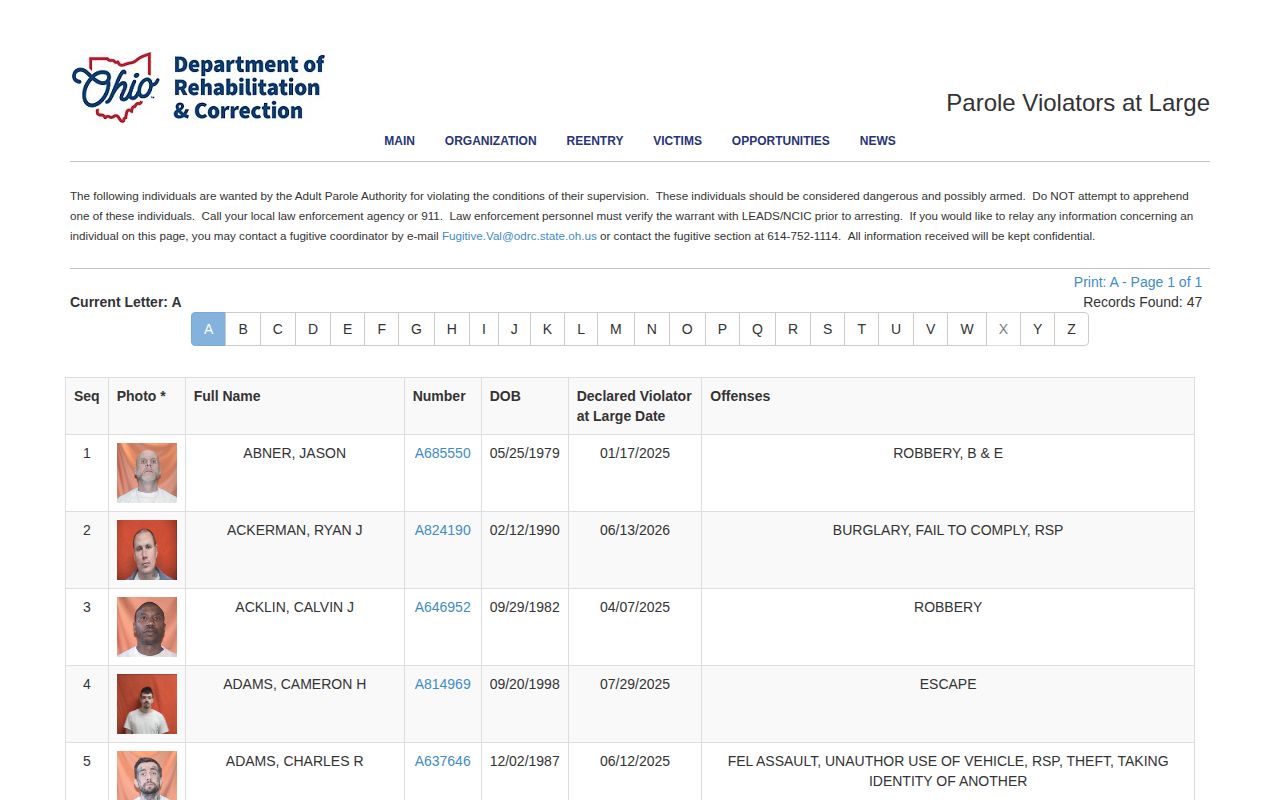
A matching name alone is insufficient. Confirm the offender number and identity fields, then rely on the responsible agency for any live warrant status.
Note: A violator-at-large label concerns alleged noncompliance after release and does not identify the person's present location.
Summit County Supervision and Discharge
Supervision conditions vary with the sentence and governing order. ODRC's standard conditions include keeping APA informed about residence and reporting an arrest by the next business day after release from custody. Those public standards explain why a record may name an APA unit. They do not replace the instructions issued to a specific releasee. Questions about reporting, travel, treatment, or other terms belong with the supervising officer and counsel.
A possible violation does not itself reveal the final result. APA may address an alleged state-supervision breach through its process, while a Summit court handles an alleged community-control violation through the case docket. Look for journalized findings, modifications, revocation, or termination. Revocation means supervision was withdrawn and custody may resume. A warrant or hold from another agency can also affect the custody path.
Supervision ends through a formal discharge, termination, expiration, or other authorized action. For county community control, find the court's termination or discharge entry. For APA supervision, check the ODRC status and supervision period, then verify a disputed or recent change with ODRC. The broader Summit County released-inmate search explains how to pair a supervision record with the original jail release and court disposition.
Ohio public-record law also sets limits. Probation, parole, and post-release-control proceeding records are excluded from the ordinary public-record definition under Ohio Revised Code 149.43. A public status summary can still be available, but it does not open the whole supervision file. Request only the record needed and expect protected parts to remain confidential.
Summit County Judicial Release Path
Summit Reentry Court creates a local record chain that does not fit a simple parole-versus-probation label. The Common Pleas Reentry Court describes a collaboration among the court, Adult Probation, and Oriana House. A judge refers a person being considered for judicial release. An assessment follows, and the court decides whether release is granted.
If granted, the person may enter community supervision or an Oriana residential placement based on assessed need. A residential program is not the Summit County Jail and is not proof of unrestricted movement. ODRC may display RELEASED - Judicial Release, while the Summit Common Pleas docket carries the controlling order and later review entries. Together, the state status, court order, and program or probation record explain where the person went and who supervises the release.
This local chain matters when dates appear to conflict. The court can authorize judicial release before an earlier state projection, but physical departure and placement can follow after paperwork and transport. Read each source for the event it controls rather than forcing all records into one date.
Note: Judicial release is court-authorized departure from prison, usually with terms; it is not the same process as parole.
Property During Summit County Supervision
A separate Summit jail rule can matter while a person remains in custody before supervision begins. The Sheriff's Corrections FAQs says third-party property release is available on weekdays from 8:00 to 11:00 a.m. The jail will not carry a message asking someone to prepare a property release. Driver licenses, Social Security cards, Direct Express cards, Direction cards, and other identification are excluded from that third-party process.
This rule concerns release of property to someone else while custody continues. It does not state that a person gives up identification or cards at their own release. Keeping that distinction clear prevents a property procedure from being misread as a post-release condition. Once supervision begins, personal reporting and identification needs should be addressed through the instructions from the court or APA, not inferred from the jail's third-party pickup rule.
For a recently released person, the jail can explain its own property process, while the assigned supervision office can explain reporting needs. Those are separate tasks and separate records.